Guide
How to Choose a Memory Supplement: A Six-Step Checklist, With Memocept Scored
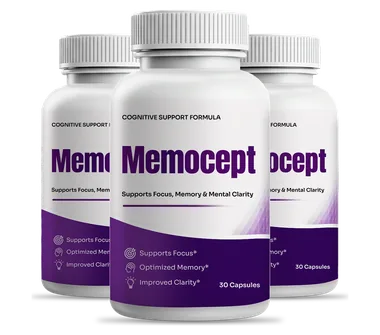
Check six things: a full panel with amounts, doses that match research, evidence for the claimed use, claims that follow FDA and FTC rules, interaction risks and a clear refund path. Memocept passes on the panel, the claim wording and the refund path. It falls short on doses and on memory evidence, since arginine and citrulline sit far below studied amounts.
The checklist
What should you check before buying any memory supplement?
Six questions sort a careful label from a weak one.
Check the label before the marketing. The six steps below work for Memocept and for any other memory or focus product on the shelf.
Full panel with amounts
Every ingredient should list its own amount per serving. A "proprietary blend" with one total hides the doses.
Doses versus research
Compare each amount with the dose used in studies.
Evidence for the claimed use
Ask whether the ingredients were tested for memory in people.
Claims that follow the rules
Look for the standard FDA statement and support-style wording, not disease promises.
Interaction risks
Match the ingredients against your own medicines and health conditions.
A clear refund path
Know who holds the guarantee, how long it lasts and how to claim it.
Step 1
Does the supplement list every ingredient with an amount?
A good label names each ingredient and prints its amount per serving. FDA rules require the amount per serving, and ingredients with no Daily Value are marked as such (FDA, Labeling guide).
Many brain products use a proprietary blend instead. The blend shows one total weight, so you cannot tell whether a key ingredient is a real dose or a sprinkle.
Memocept publishes its full Supplement Facts panel. All seven ingredients show an amount per capsule, adding up to 665.5 mg. That is better than many products in the category.
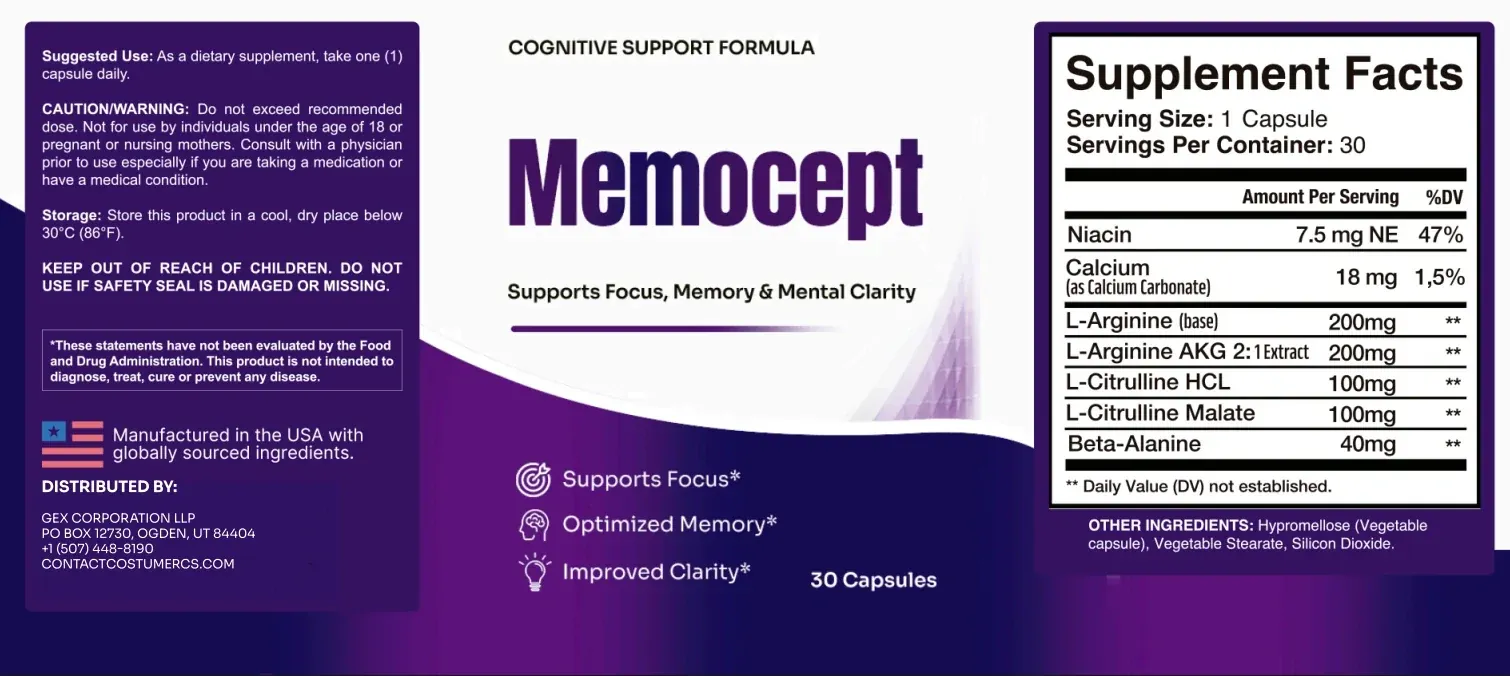
Read the full transcription on the Memocept Supplement Facts page.
Step 2
Do Memocept's doses match the amounts used in research?
No, not for the amino acids. Arginine, citrulline and beta-alanine each sit at a small fraction of the lowest dose used in studies.
- Niacin (vitamin B3)7.5 mg NE
- Calcium18 mg
- L-arginine200 mg
- Arginine alpha-ketoglutarate (AAKG)200 mg
- L-citrulline HCl100 mg
- L-citrulline malate100 mg
- Beta-alanine40 mg
Against the doses used in research
- Arginine (both forms)(ODS, Exercise supplements)Label 400 mg · studied 2 to 10 g a day, most often20%of the lowest studied dose
- Citrulline (both forms)(Barkhidarian et al., 2019)Label 200 mg · studied 3 to 9 g a day in blood pressure trials6.7%of the lowest studied dose
- Beta-alanine(Trexler et al., 2015)Label 40 mg · studied 4 to 6 g a day recommended1%of the lowest studied dose
- Niacin 7.5 mg NE47% of the 16 mg Daily Value; the adult upper limit is 35 mg (ODS, Niacin)
- Calcium 18 mgabout 1.4% of the 1,300 mg Daily Value (the label prints 1.5%) (ODS, Calcium)
Bars are to scale against the lowest dose in each study range. The research on these amino acids looked at exercise and blood pressure, not memory or focus.
The two nutrients tell a different story. Niacin at 7.5 mg NE is 47% of the Daily Value, a real amount (ODS, Niacin). Calcium at 18 mg is close to trivial next to a daily need of 1,000 to 1,200 mg (ODS, Calcium).
Step 2, in detail
How does each Memocept ingredient compare with studied amounts?
The table puts the label amount next to the research or reference amount for all seven ingredients.
| Ingredient | Per capsule | % Daily Value | Research or reference amount |
|---|---|---|---|
| Niacin | 7.5 mg NE | 47% | RDA 14-16 mg NE; upper limit 35 mg (ODS, Niacin) |
| Calcium (as Calcium Carbonate) | 18 mg | 1.5% (as printed) | RDA 1,000-1,200 mg (ODS, Calcium) |
| L-Arginine (base) | 200 mg | Not established | 2-10 g a day in most exercise studies; 4-24 g in blood pressure trials (ODS, Exercise supplements) |
| L-Arginine AKG 2:1 Extract | 200 mg | Not established | 3,000 mg before exercise (no benefit) (Wax et al., 2012) |
| L-Citrulline HCL | 100 mg | Not established | 3-9 g a day in blood pressure trials (Barkhidarian et al., 2019) |
| L-Citrulline Malate | 100 mg | Not established | Up to 8 g in one exercise study (ODS, Exercise supplements) |
| Beta-Alanine | 40 mg | Not established | 4-6 g a day (Trexler et al., 2015) |
Step 3
Is there human evidence that the ingredients help memory or focus?
For Memocept, not in the sources we checked. The research on arginine, citrulline and beta-alanine looks at exercise and blood pressure (ODS, Exercise supplements).
- Ask what outcome a study measured. Blood flow or muscle output is not memory.
- Ask who was studied. Athletes or heart patients may not look like you.
- Well-known brain supplements fare no better: NCCIH found no conclusive evidence for ginkgo, omega-3s, vitamin E or B vitamins (NCCIH, Supplements and cognition).
- Ask whether the product itself was tested. Memocept has no published trial.
Our Memocept ingredients guide covers the research on each one.
Step 4
What do FDA and FTC rules mean for memory supplement claims?
Dietary supplements reach store shelves with no FDA approval step (FDA, Supplement Q&A). Sellers may make structure or function claims, such as "supports memory", only with the standard FDA statement.
No approval step
A badge claiming FDA approval on a supplement is false. Look for the "not evaluated by the FDA" statement instead (FDA, Supplement Q&A).
Claims need proof
Health claims need competent and reliable science, usually randomized trials. Customer stories never count (FTC, Health claims).
Regulators do act
The FTC and FDA have sent warning letters to sellers of brain supplements over memory and Alzheimer's claims (FTC and FDA, 2019).
Memocept's label uses support wording, and the claims carry an asterisk. That fits the rules. It is still not evidence that the product works.
Step 5
Could a memory supplement interact with your medicines?
Yes, and the risk depends on the ingredients. For Memocept, the main concern is blood pressure.
Arginine may lower blood pressure too far when taken with blood pressure drugs, nitrates or sildenafil, and it is not recommended after a recent heart attack (Mayo Clinic, L-arginine). Ask your doctor before use.
That warning traces to the VINTAGE MI trial, which used 3 g of arginine three times a day. It stopped early after six deaths on arginine and none on placebo (Schulman et al., 2006).
Also count niacin from all sources. The upper limit from supplements is 35 mg a day (ODS, Niacin). Full details are on the Memocept side effects page.
The verdict
How does Memocept score on the memory supplement checklist?
Memocept passes three of six checks, gets partial credit on one and falls short on two. The table shows each result and why.
| Check | Result | Why |
|---|---|---|
| 1. Full panel with amounts | Pass | All seven ingredients list an amount per capsule. |
| 2. Doses versus research | Falls short | Amino acids are well under 20% of the lowest studied doses. |
| 3. Evidence for memory or focus | Falls short | No human memory research on these ingredients; no product trial. |
| 4. Claims and rules | Pass | Support wording with asterisks; no disease claims on the label. |
| 5. Interaction risks | Partial | Label cautions are clear, but blood pressure effects need a doctor's view. |
| 6. Refund path | Pass | 60 days from purchase, claimed by phone at +1 (507) 448-8190. |
The terms of that refund window are on the Memocept guarantee page.
Red flags
Which red flags should rule out a memory supplement?
- Promises to undo memory loss or to treat dementia.
- A badge that claims FDA approval.
- A proprietary blend with no single amounts.
- Star ratings or quotes with no way to check who wrote them (FTC, Online reviews).
- No phone number or address for refunds.
Sources
Which sources back the memory supplement checklist?
Each source below is linked in full. Most are U.S. agencies, plus the key trials behind the dose ranges.
- Niacin: Fact Sheet for Health Professionals. NIH Office of Dietary Supplements, 2022.Adult RDA 16 mg NE (men) and 14 mg NE (women); DV 16 mg. The upper limit for supplemental niacin is 35 mg, set to avoid skin flushing.
- Dietary Supplements for Exercise and Athletic Performance: Fact Sheet for Health Professionals. NIH Office of Dietary Supplements, 2026.Arginine studies used 2-20 g a day (most often 2-10 g); citrulline up to 6-9 g; beta-alanine 4-6 g a day, with tingling from about 800 mg. The sheet covers exercise, not memory.
- L-arginine. Mayo Clinic, 2026.Not recommended after a recent heart attack. With blood pressure drugs, nitrates or sildenafil it may drop blood pressure too low. Side effects include nausea, diarrhea, bloating and headache.
- L-arginine therapy in acute myocardial infarction: the VINTAGE MI randomized clinical trial. Schulman SP, et al. JAMA, 2006.153 heart-attack patients took 3 g of L-arginine three times daily or placebo; no benefit, 6 deaths on arginine vs 0 on placebo, and the trial stopped early.
- Dietary Supplements and Cognitive Function, Dementia, and Alzheimer's Disease: What the Science Says. National Center for Complementary and Integrative Health, 2022.No conclusive evidence for ginkgo, omega-3s, vitamin E or B vitamins in preventing or slowing cognitive decline. Arginine, citrulline and beta-alanine are not covered.
- Questions and Answers on Dietary Supplements. U.S. Food and Drug Administration, 2026.FDA does not have the authority to approve dietary supplements before they are marketed; structure/function claims need the standard FDA statement.
- Dietary Supplement Labeling Guide: Chapter IV. Nutrition Labeling. U.S. Food and Drug Administration, 2005.The panel lists the amount per serving; ingredients without a Daily Value are marked 'Daily Value not established'.
- Health Products Compliance Guidance. Federal Trade Commission, 2022.Health claims need competent and reliable scientific evidence, generally randomized controlled trials; customer stories are never enough.
FAQ
Choosing a memory supplement FAQ
Is a proprietary blend always bad?
Not always, but it hides the doses. You cannot tell whether a key ingredient is present in a useful amount.
Does Memocept use a proprietary blend?
No. The full panel lists all seven ingredients with amounts, totaling 665.5 mg per capsule.
Are Memocept's doses high enough?
Not by research standards. Arginine, citrulline and beta-alanine are far below the gram doses used in studies, and those studies looked at exercise and blood pressure.
Where can I check the Memocept label myself?
The Supplement Facts page shows the label image and a word-for-word transcription.
Keep reading
More about Memocept
Supplement Facts
Every line of the Memocept label typed out, with the math behind each Daily Value and the two label versions explained.
Read more
Memory and focus guide
Normal forgetting vs warning signs, the habits with real evidence, and what supplement research shows.
Read more
Reading a brain supplement label
A step-by-step way to read any Supplement Facts panel, with Memocept's label as the worked example.
Read moreUSA Authorized Memocept Retailer
Ready to try Memocept with the 60-day guarantee?
Order through the authorized retailer's page so your order ID is on file with the refund desk. One capsule a day; even the 2-bottle pack covers the whole 60-day window.
Questions before you buy? Call +1 (507) 448-8190. 60-day money-back guarantee, return shipping paid by the buyer.